Posted in Star Trek, Television shows, tv reviews

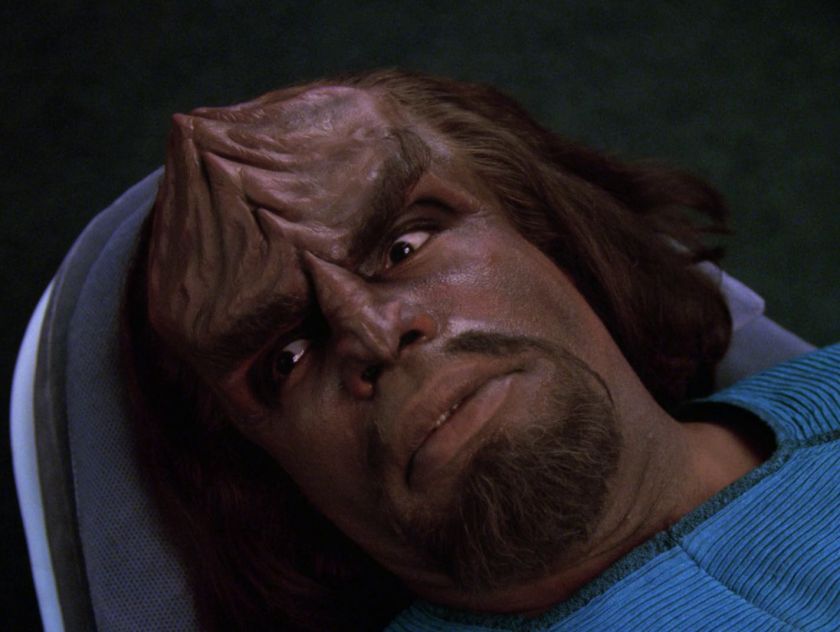
The Rewatch 238: Dark Page

Series: Star Trek: TNG
Episode: 7.07 Dark Page (October 30, 1993)
Rating: 5/5
Redshirt Status: 0/7/64

Notable Guest Stars:

Kirsten Dunst (Hedril) – Kirsten Dunst is a A-list star, known for many roles.  Her breakout role was as Claudia, a young vampire in 1994’s Interview with a Vampire, which she filmed not too long after this episode. She played Amy in Little Women (also 1994), and Judy Sheppard in Jumanji (1995). Needless to say she had a strong start. My favorite of her films is Elizabethtown (2005) Her most recent credit is Rose in The Power of the Dog (2021).

Amick Byram (Ian Andrew Troi) – Byram is known more for his music then for his acting, with several of his credits being his singing voice. He has a focus on Christian music.

Norman Large (Maques) –  While I did not recognize his name, he as appeared on several shows I have watched over the years including Veronica Mars and JAG.  He has appeared on TNG twice as of this episode, and will appear twice on Voyager.

Andreana Weiner (Kestra (1) Troi)-  I felt I should include her as she had a few seconds of screen time at the very end.  Most of Ms. Weiner’s credits appear to be behind the screen either as a crew person or as a voice. This episode is her very first credit.

Debbie David (Ensign Russell) – David appears as Ensign Russell 53 times on the show as well as the first TNG film.  They also appear as Russell (now a LT) on Voyager.  During the 90s they were credited as “Carl” David.

Majel Barrett Roddenberry returns as Lwaxana Troi,

CONTENT WARNING:  This review discusses Child Loss.

Review:

Dark Page is one of my favorite episodes.  Not only does it really dealve into the relationship between Lwaxana and Deanna, it deals with an issue you don’t find too often: Child loss and trauma.

Most of Lwaxana’s episodes are used for comedic effects.  Majel Barrett is amazing at it.  This episode, however, allows her to flex her drama wings.  Both she and Marina Sirtis do an amazing job in this episode. 

The episode starts with Lwaxana helping The Carin learn verbal language to help them communicate with other species, as they are a telepathic species. The amount of telepathic effort to communicate with them has weakened her, and it has allowed some of her meta-conscious to drip into her consciousness.  It appears that Lwaxana has suppressed the memories of her first-born daughter – Kestra – to the point that it is mentally harming her.  Deanna has no memories of her sister, and apparently Lwaxana was able to have everyone – her husband, her friends and family, her butler – pretend Kestra never existed so she wouldn’t have to deal with the grief that overpowered her.

This never ends good in the real world, and it doesn’t in Trek world either.  Lwaxana ends up collapsing after Hedril, a girl who reminds her of Kestra, falls in a shallow pond in the arboretum. They don’t say what happened to Kestra, but its strongly implied that she drowned, having chased her dog into the lake which is why Hedril falling effected her so badly. 

Deanna has to enter her mother’s mind, with the help of Hedril’s father Maques, to help her deal with her trauma and come back to consciousness.

They end the episode with Deanna and Lwaxana embracing as Lwaxana begins to talk about her daughter after 30 years of not saying anything at all.

This episode is important for Deanna as a character, if not to the franchise as a whole.  It gives more depth to her background, and to Lwaxana in particular.  It also sets a foundation for Deanna’s naming choices.  I have not watched Picard, but I know Deanna names her daughter after her long lost sister Kestra.

So excellent storytelling, excellent acting.  I’m giving this a 5/5

Interesting Notes:

  • Written by Hilary J. Bader (with polishing by Rene Echevarria)
  • Directed by Les Landau
  • This is Majel Barrett Roddenberry’s last appearance as Lwaxana on TNG.  Her remaining Trek appearances (other then her voice for the computer) will be on DS9.
  • Bader had worked on this script for quite awhile, changing characters and the reasons why there was a telepathic rescue.  Eventually she came to this version.
  • Marina Sirtis did her own stunt in this episode.

Pros:
This brings a lot of detail into the backstory of Lwaxana Troi and through her, Deanna Troi.

Cons:

Screencap via CygnusX1.net

Posted in Rewatch, Star Trek, Television shows, tv reviews

The Rewatch 209: Chain of Command (1 & II)

Series: Star Trek: TNG
Episode: 6.10-11 Chain of Command (Part 1: 12/4/92  Part 2: 12/21/92)
Rating: 4/5
Redshirt Status: 0/3/38

Notable Guest Stars:
Ronny Cox (Edward Jellico)- I know him best as Senator Kinsey, the thorn in the side of the Stargate program.
Natalia Nogulich (Alynna Nechayev)-
She will return as Nechayev several times over the course of TNG and DS9.  She has also appeared on the West Wing as an Israeli ambassador.
John Durbin (Gul Lemec)-
Durbin will appear on DS9 and Voyager as various characters.
David Warner (Gal Madred) –
David Warner previously was in the Undiscovered Country as Chancellor Gorkon.  He had also previously worked with Patrick Stewart on a performance of Hamlet.

Warning: This episode contains possible triggering content such as torture and gaslighting. When watching it has graphic torture scenes.  My review also references them, though I will not describe them in detail.

Review:

This duo has a lot to unpack. It’s a fairly important episode Franchise wise for a couple of reasons. There are several character development scenes in these episodes from a TNG standpoint. It also sets the stage for DS9, which will premiere next (and shall be Rewatch 209).

Admiral Nechayev comes onboard the Enterprise to surprise Picard with a special mission to go undercover and seek out a possible metagenic weapon which makes current biowarfare seem like toys. He is relieved of duty as Captain and Edward Jellico, a more by the book and militant style Captain is brought in to relieve him.

Jelico is a bit of a debate.  Some fans feel he was an amazing captain, others fell the opposite. I’ll get to my own opinion in a bit.  Regardless he makes an impression because as soon as he transports over, he starts to change the way the ship works. He wants them to switch up their duty schedules into four shifts rather then three.  Which honestly doesn’t quite make sense.  A four duty shift means six hour shifts. It would spread the crew more thinly, and also seems a waste of resources.  But he’s preparing for war, so perhaps he’s trying to make sure everyone is well rested in case of battle.

He also has requests of each department that sometimes borders on incompletable.  For example, despite Data saying it was an attainable goal, Geordi knows it will take the whole department two days of round the clock work to complete.  And Jellico removes part of the tema for security.

Isn’t there already a security department on board?

Its hard to tell with Jellico if he’s just being premptifully prepared or just has unrealistic expectations of his crew on an larger ship.  Either way it puts him at odds with Riker, who is more of a relaxed command structure kind of guy.  Which is good for the Enterprise because it’s a science ship, and he knows his crew and when to be more firm then others.  Might not be so great when it comes to militiarlistic situation.  That being said, Riker has already shown he can take command of those situations.  He did so in The Best of Both Worlds.

Jelico also makes Deanna wear a uniform, which is probably my favorite thing about this whol episode.  It always bothered me that Deanna never wore her uniform unless it was in an alternate timeline or the first episode.  It has been argued that she wears something to make her patients feel more comfortable, but always?

Meanwhile while Jellico and Riker are fighting (and Deanna playing mediator) Picard, Crusher and Worf are all sneaking into what is supposed to be a Cardassian lab.  Except it was just a lore to get Picard.  To get information about a planet they want. Information that Picard does not have.

Picard is tortured in this episode both mentally and physically.  He spends a portion of this episode strategically placed as he is nude.  They don’t shy away from the fact that this is in fact a torture scene. The most popular phrase to come out of this episode is “THERE. ARE. FOUR. LIGHTS.” It comes from when Picard is being tortured while being asked how many lights there are.  He is tortured to the point that he admits (later to Deanna) he almost gives up and says there are five lights just to get relief.

.I do think it is important that afterwards he goes to talk with Deanna. He seeks mental health services, instead of the usual “forget anything happened to him before this” situation that TV dramas seem to take as their go-to.   He’s seen seeing his therapist, even if it seems like he’s just sitting down with a friend. I think that is a very good sign.  I wish that TV shows would show their heroes seeking mental health help when they need it.

This episode develops Picard, as information of his past come to light. Some of which we already knew, some of which is new. It definitely showcases his character, and how he deals with things. He is rescued before he breaks down from the torture, but he still admits at least to Deanna that he was close to just believing there were 5 lights.

It develops Riker to a certain point, because it shows how willing he is to rebel when he doesn’t think the commanding officer has the best interests of the crew in mind.  Although I do think that he’s a little reactive in this episode, considering he himself has had to deny going back to get someone till after they finish something else.

I do find it funny that all of a sudden he is the best pilot on the enterprise but we hardly ever see him fly anything.

Interesting Notes:

  • Written by (Part One) Frank Abetemarco and Ronald D. Moore (Part Two) Frank Abetemarco
  • Directed by (Part One) Robert Scheerer and (Part Two) Les Landau
  • This episode has a homage to the George Orwell classic “1984”.In the novel, a character uses gaslighting to mentally manipulate someone into believing an alternate reality (five fingers instead of four, or in this case, five lights instead of four)
  • This episode was originally meant to be a one parter, but they decided to stretch it out into a two parter to help save on their budget.  In the end it ended up being a good decision because the story needed both parts.
  • David Warner was a last minute casting, as the actor who had been cast had to pull out for undisclosed reasons.  He had to have his lines held up because he had no time to learn them.  Considering all that, he did an excellent job.
  • This episode was meant to help establish the situation around DS9, with references to Cardassia’s history, and their removal from the Bajoran sector.  Solok was originally meant to be Quark, but it was decided against that when they got to the final script.
  • Abetemarco did research on torture responses with Amnesty international to get the scenes right. Patrick Stewart also made sure to do research into make this episode believable.

Pros

  • Excellent acting by Patrick Stewart.  This is perhaps one of the darker episodes of TNG and he did a great job in showing Picard’s struggle.
  • Excellent acting all around really.
  • Deanna Troi gets her uniform back. If nothing else, I thank Jellico for that.

Cons:

  • While I don’t think Jellico was a bad captain, I feel he could have saved himself some energy and figured out what was working on Enterprise before trying to alter it.  Many arguments can be made over his overall choices though.

Screencap via CygnusX1.net

Posted in rant, Rewatch, Star Trek, Television shows, tv reviews

The Rewatch 190: Ethics

Series: Star Trek: TNG
Episode: 5.16 Ethics (2/17/1992)
Rating: 3/5
Redshirt Status: 0/1/35

Notable Guest Stars:
Caroline Kava (Toby Russell)-  Kava is not only an actress but a playwright.  She has written and or adapted several plays for off-Broadway performance.

Review:

CONTENT WARNING: This review, due to the episode, contains references to Assisted Suicide/ Suicidal thoughts.

Continue reading “The Rewatch 190: Ethics”