Posted in American History, essay, history, Politics

The Amendments: Two

A well regulated Militia, being necessary to the security of a free State, the right of the people to keep and bear Arms, shall not be infringed. (Source)

The Second Amendment (part of the Bill of Rights, ratified in 1791)is perhaps the most abused, debated and known Amendment.  I honestly thought about skipping this one till the end, but in the end decided to stick to the order they came in.

I’m pro-gun control.  I am not however against people having guns.  I’ve always believed this law is about being able to form a community militia.  It does not bother me that people own guns.  Some people hunt, some people use it for protection.  I do however think that there are some common sense gun laws that could go into affect that don’t affect one’s right to bear arms.

Both sides use this one a lot.  The Pro-gun lobby seems to believe that any form of gun-control (even something as restricting gun magazine sizes) is an infringement.  The Pro-Gun control group has many facets ranging from the mid-grounders like myself who just want tighter background checks, better regulation of gun ownership (basically making sure people who buy guns actually know how to use them) to the stricter varieties who want guns gone all together outside militia groups.

This Amendment protects the right of the citizen to protect themselves from military take-over. It protects the right of small militia groups to form.   It’s debatable if it protects against certain guns (Like AK-47s and more militaristic weapons) being regulated.

It also brings up the debate of whether Amendments can be timeless.  That some laws/Amendments might have to be altered, as technology improves and the country as a whole realises the original intent needs adjusting (there are several amendments which are basically  doing just that).

This is a hot button issue.

My personal belief is that one should only have the guns you need to protect yourself and/or hunt.  Unless you are some collector getting antique guns, you really don’t need to arm yourself like you are your own one-person militia.  And if you want a gun, you should take the time to learn how to properly use it, clean it and store it.  I see way too many stories on the news about people accidently getting shot because they didn’t clean it right, or they didn’t store it right and some kid got into it, or they did something stupid and ended up shooting their foot off.

I know people who believe the opposite, ranging from more open about gun use to those who make me wish guns were taken away so they didn’t have them.  I also believe this Amendment protects your right to own a gun, not your right not to have guns safety laws and regulations.
Posted in American History, essay, history, Politics

The Amendments: One

Congress shall make no law respecting an establishment of religion, or prohibiting the free exercise thereof; or abridging the freedom of speech, or of the press; or the right of the people peaceably to assemble, and to petition the Government for a redress of grievances. (Source)

This amendment, ratified in 1791 as part of the Bill of Rights, has a lot in it.

  1. Congress can not make a law that either establishes one religion over another or prohibiting people’s ability to practice the religion of their choice.
  2. Congress can’t take away the freedom of speech, or the citizens right to have free press.
  3. Congress can’t stop a assembly if it’s peaceful even if it’s against something they did.


This is where people usually go to when they try to explain why laws that are obviously religion based in nature are unconstitutional, even if you believe our country was founded on Christian principles. This was a reaction to Britain’s state religion and how alternative religions including alternative practices of the state religion were often considered criminal.  Many of the first colonists were coming because they wanted to practice their religion in peace in the way they choose.  And this right protects this. It also protects those who believe differently then you from being forced to worship in the same way if you are the one with power.

This does not however outlaw a lawmaker using his religion to influence his decisions, even if we disagree with them.

This amendment also protects our freedom of speech.  Which yes, does mean we can say what we want to say. We can all have opinions.  This does not however protect you from receiving consequences from utilizing your freedom.  I have seen people say stupid and/or cruel things and when they are confronted scream FREEDOM OF SPEECH.  Ok, that means you have the right to say what you want to say, not that people can’t react to it.  Mostly this refers to the citizenry’s right to protest it’s government.  To be able to disagree with our leaders without being arrested for it.  To have ability to form our news organizations without it being controlled by our government.

The third element of this amendment is to make it so the government can’t arrest people who are peacefully protesting the government.  This has been a challenge for some smaller governments as they have long-term protests that disrupt things that have no relation to the protest.  It goes with the Freedom of speech.  You have the right to protest, but if you do something stupid with your freedom you might end up having consequences.


Posted in American History, history, Politics

The Amendments: An Intro

I’ve noticed that in a lot of the recent elections that amendments of various kinds have come up on all sides on whether you should or shouldn’t vote for a person.  And While I have read the constitution before, I never really mesmerized the amendments.  Therefore I have decided to go through each one and write a post on each one, hopefully completing this series before the November Election.

This is primarily a place for me to write my thoughts on the amendment and put in what I learned.  Feel free to comment, but remember to be polite especially to anyone else who comments.  Politics can get under people’s skins pretty fast, especially when one has a differing opinion.

There are 27 amendments, although 33 have been proposed.  In order to be official, it must be ratified by a majority of the states after going through a congressional vote and being sent to the states to sign. Continue reading “The Amendments: An Intro”

Posted in American History, essay, Politics

Voting & The Electoral College

(I am an American, so this post is about the United States election system.  If you are a non-American reader, I would love to hear about how your election systems differ)

Many times I have heard people claim they don’t vote because it isn’t like their vote matters anyway; in the end the Electoral college chooses, not the people.  And in a sense they are right.  Since the US is a Republic, we choose representatives based on population.  Therefore states with more population have more electoral votes in the college. Therefore places more heavily populated tend to get favored in the Electoral college.

Except for two facts:

Continue reading “Voting & The Electoral College”

Posted in American History, history, Politics, Uncategorized

This Day In History

I looked up what important things happened today in history (other then it being my cousin’s birthday) and some pretty interesting things came up on the Google Search.  I took most of this information from History.com and the New York Times “On This Day” feature.

Washington

On February 4, 1789  George Washington was unanimously elected by the electoral College.  He’s the only president to do so.

Also, on this day 6 years earlier Britain formally acknowledged they were done with the Revolutionary War.

Confederate Congress

In 1861, The Confederate Congress (a provisional one anyway) opened for business, thus starting


Snow White

One of Disney’s most known films (probably because its one of the firsts) is released on this day in 1938

Yalta Conference

(1945)Basically this is the photo op picture we always see when talking about the end of WWII and they show us that picture of Roosevelt, Churchill and Stalin sitting out on the Lawn as if they are talking about the latest football game rather then what to do in the last months of the war.  It did however start to show that the Alliance was not as strong as it could have been, and the cracks that caused the ‘Cold War’ formed.

Palestine

Yasir Arafat helps found the Palestine Liberation Organization in 1969.

Patty Hearst

I don’t really know much about what happened here, but Patty Hearst may be one of the most famous kidnapped women in American history.  Today’s the anniversary of her kidnapping in 1974, so 41 years ago.  She eventually served a prison sentence for her involvement with the Symbionese LIberation Army’s activities.  She was pardoned in 2001 by President Clinton.

Yugoslavia

Its no more as of February 4, 2003.  Its now several different countries.

For more events, try this page.

Posted in American History, history, space history

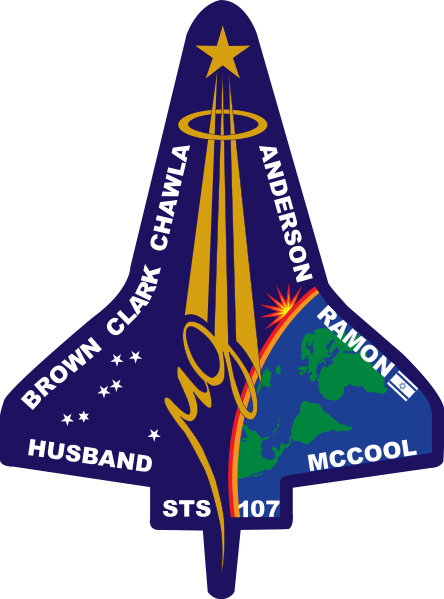
In Memoriam: The Columbia STS-107


444px-STS-107_Flight_Insignia.svg
The STS-107 Patch


On February 1, 2003 (13 years ago Monday), the space shuttle Columbia  mission STS-107, disintegrated in the atmosphere over Texas and Lousiana.  Seven people died, and it caused a two year downtime for the Shuttle program while ships were reassessed and refitted to be safer; similar to what happened after the fire on Apollo 1.

Continue reading “In Memoriam: The Columbia STS-107”

Posted in American History

Challenger & Apollo 1

This week has two major NASA tragedies, so I thought I would write a post about them.  Space Flight history as been an interest of mine since I was in elementary school.  Its always seemed strange that all the major disasters that become national news (because there were some that never were big stories) happened during the last weeks of January into the first weeks of February.

Its also a reminder that despite the fact that seems almost common place now to go into space and investigate and come back, it really is a dangerous job, and things can go wrong without any warning.

Challenger Accident – January 28, 1986

655px-STS-51-L.svg
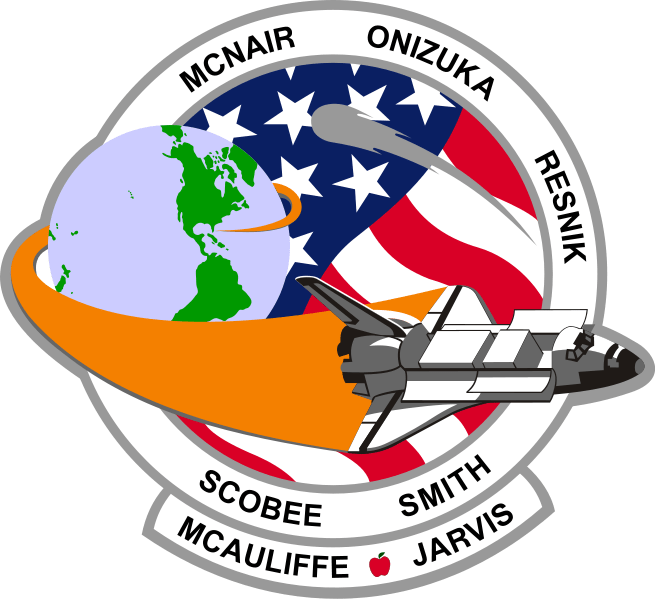
Mission Patch for 51-L Challenger. Source: Wikipedia/Public Domain

Today is the 30th Anniversary of the Challenger Accident.

I can’t say I ‘remember’ the incident.  I was only a few weeks old, so obviously I don’t.  However when Apollo 13 came out and I became interested in space travel and its history I felt connected to this one since it happened so close to when I was born.

On January 28, 1986  Challenger took off from Florida carrying on board seven crew members.  It had been a cold morning in Florida and the rapid heat up apparently broke one of the seal rings on the ship.  Halfway up, the ship disintegrated and fell into the ocean.

All on board were killed:

(copied and pasted from Wiki, so those links should lead to Wikipages)

This space flight was notable because Christa McAuliffe was a teacher who had trained to go up as part of a program involving ‘civilian’ crew.  It also caused a 2 year shutdown of the space program where NASA reviewed procedures, and components of the ships themselves to make sure they were all safe to fly in.

The next mission to go to space was the STS-26, Discovery in September 1988.

More About the Challenger:

Video of Face The Nation (2/2/86) about the accident.

Wikipedia: The Space Shuttle Challenger Disaster

NASA:  Challenger 51-L Mission

Apollo 1 Fire:  January 27, 1967

595px-Apollo_1_patch
The Apollo 1 Mission Patch (Source Wikipedia, Public Domain)

Apollo 1 was to be the first manned mission for the Apollo class spacecraft.  It would be this class that would see us reach the moon.  However, on January 27, 1967 the ship burst into flames claiming the lives of three men during a routine pre-launch test.

Two of the men killed were veteran Astronauts.  Gus Grissom and Ed White (known for taking the first space walk).  The third member was a rookie astronaut named Roger Chaffee.

This accident led to a major investigation, and quite a few changes to the Apollo space craft.  One major chance was that the oxygen that had been pumped into the command capsule was no longer pure oxygen, but a mix closer to what we breathe normally on earth.  Pure Oxygen is extremely flammable.

Changes were also made to the capsule to improve safety measures.  The investigation and changes took a year and a half to complete.  The first manned mission afterwards was Apollo 7 in October of 1968.  Undamaged parts of the rocket were used in unmanned missions testing the other parts of the ship during the 20 months the command module was out of duty.

The launch pad they were to launch from was only used once more for Apollo 7, then dismantled and is now a memorial site to the lost crewmen.

Next year will be Apollo 1’s 50th anniversary.

NASA:  Day of Remembrance

Wikipedia: Apollo 1


Posted in American History, history

Mr. Washington, I presume.

So as I said in my last post, I’ve made an attempt to start reading books about Presidents so I can say I know something they did while President besides be President.  I decided to start in order, because I might as well.  (A legitimate “because of reasons” responce).

So we start with George Washington, our first president.  Or rather our first president once we got the right constitution in order.

George Washington is a pretty well known President.  Its hard to forget the name of the guy who basically had to set up the office himself.  I found a book available through Kindle Unlimited and started to read, to see if I could learn anything different about our President.

It wasn’t exactly the most enlightening book I ever read as far as a bio went, but I got some new impressions.  Basically George Washington’s reasons for joining in the revolution had some tints of ego (the British Military wouldn’t accept him as an officer because he was American born.) and really all he wanted to do was settle down on his farm and make money.

What was interesting was his involvement in Western Pennsylvania.  He actually owned land in the Ohio River Valley, and wanted to build a canal into Virginia, this controlling the shipping of the area.  Smart Idea that never went anywhere (sadly for Washington).

But basically he would go home, set it to rights again and be happily ordering people to farm for him when Congress would whine and bring him back in again.

All Washington wanted was a break.  I think he probably hated congress as much as we do now.

Maybe I should have chosen a different book, and I’m sure that the following presidential summaries will be better if only because I’ll write them sooner after I read the book.

In summery

  • Washington wanted to join the British Army but they wouldn’t let him be an officer because he was American Born.
  • He basically designed the office of the Presidency because no one had been there before.
  • He hated the ideas of political parties, but Jefferson and Hamilton couldn’t let us have nice things
  • All he wanted to do was hang out with his wife and look after his properties in the quiet of Virginia.